How to Read a Vintage Japanese Pokémon Card
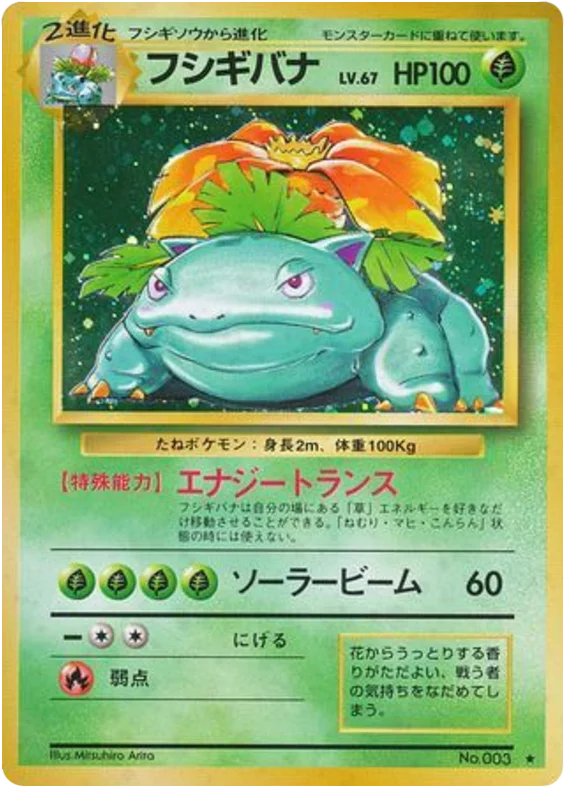
Pick up a 1990s Japanese Pokémon card and the printing looks familiar — until you try to find the card number. There’s a big “No. 003” on the Venusaur, but the set has far more than three cards. The trick: on vintage Japanese cards, that number is the Pokédex number, not the set position. Once you know that, the whole card reads cleanly.
The number is the Pokédex number
English and modern cards use an X / Y format — card 4 of 102. The early Japanese sets (Base Set through the Neo series) did something different: they printed the National Pokédex number. So the Japanese Base Set Venusaur is No. 003, Charizard is No. 006, Blastoise is No. 009 — the same numbers you’d see in the games. There is no “/ 102” because these sets simply didn’t print a set total.
The corner symbol = rarity
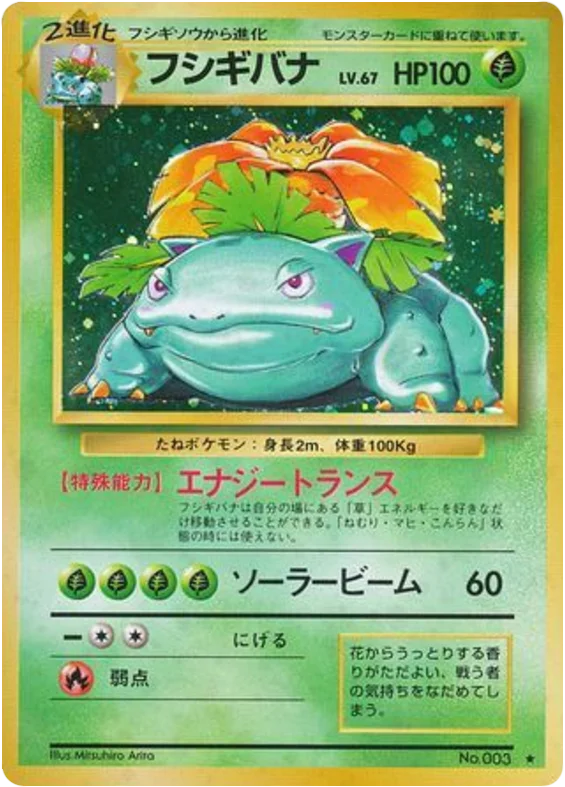
Look at the bottom-right corner, just under the HP. A circle means common, a diamond uncommon, and a star rare (holo or non-holo). If that corner is empty, you may be holding a 1996 first print — the No Rarity cards predate the rarity-symbol system entirely. That single empty corner can be the difference between a common card and a five-figure one.
Reading the set
The set is identified by the logo and the expansion name on the card and its booster — Base Set is 拡張パック (“Expansion Pack”), and later sets carry their own marks. Combine the three signals — name, set, Pokédex number — and any vintage Japanese card resolves to exactly one entry. That’s the same key we use to line our catalog up with real sales, so a price always belongs to the right card and not a same-numbered impostor from another era.
Why it matters for value
Mis-reading a Japanese card is mis-reading its price. A modern “006/021” Charizard EX and the 1996 Base Set Charizard share a “006” and nothing else — one is a recent bulk card, the other a piece of history. Knowing how the number, symbol and set work together is what keeps you from overpaying for the wrong print, and what lets a market view show you the median of real sales for the exact card in hand rather than a blurry average. The deeper contrast with the English hobby is in Japanese vs English cards.
- On vintage Japanese cards the big “No. XXX” is the Pokédex number, not the set position.
- The same number repeats across sets — identify a card by name + set + number, never number alone.
- The bottom-right symbol is rarity: circle/diamond/star; an empty corner can mean a 1996 No Rarity first print.
- Reading the card correctly is what keeps a modern same-numbered card from polluting a vintage price.